
A guest begins assessing a hotel’s quality before reaching their room. The stone wall behind reception, the texture of the lobby floor and the way lighting interacts with surfaces all contribute to that first impression. However, selecting onyx and marble for hotel projects involves more than creating an impressive appearance. Suitability for the intended application, maintenance requirements, supply availability and installation details also influence the success of the investment.
A backlit onyx panel can turn a reception area into a memorable focal point. Carefully selected marble slabs can create a consistent design language across lobbies, corridors and bathrooms. Conversely, an unsuitable finish, incomplete sample review or poorly planned slab cutting can increase costs, create visual inconsistencies and introduce unexpected operational challenges.
This guide is designed for hotel owners, architects, interior designers, procurement teams, and installation contractors seeking to make informed natural stone selections for hospitality projects. Understanding Onyx or Marble requires looking beyond colour and visual appeal to consider application suitability, technical specifications, durability, maintenance requirements, and overall project costs. By evaluating these factors together, professionals can choose the right material for reception desks, hotel lobbies, corridors, bathrooms, and other key spaces, creating a refined guest experience while meeting the practical demands of daily hotel operations.
içindekiler
- 1 Is an Attractive Stone the Right Stone for Your Hotel?
- 2 Onyx or Marble? Let the Application Guide the Choice
- 3 Lobby and Reception: Create a Strong First Impression with Control
- 4 Restaurants and Bars: Balance Statement Surfaces with Everyday Use
- 5 Hotel Bathrooms and Spas: Consider the Complete Installation System
- 6 Hotel Suites: Create a Luxury Impression Through Balance
- 7 Bookmatched Onyx and Marble: Plan Symmetry Before Cutting
- 8 How Should You Check Slab Quality?
- 9 Backlit Onyx Panels: Details That Shape the Finished Result
- 10 How to Calculate Onyx and Marble Costs for a Hotel Project
- 11 A Procurement Plan That Helps Prevent Delays
- 12 Stone Selection Is Incomplete Without a Maintenance Plan
- 13 The Final Procurement Check: Make the Decision with Evidence
- 14 Conclusion: The Right Hotel Stone Fits the Entire Project
Is an Attractive Stone the Right Stone for Your Hotel?
Define the requirements of each space first
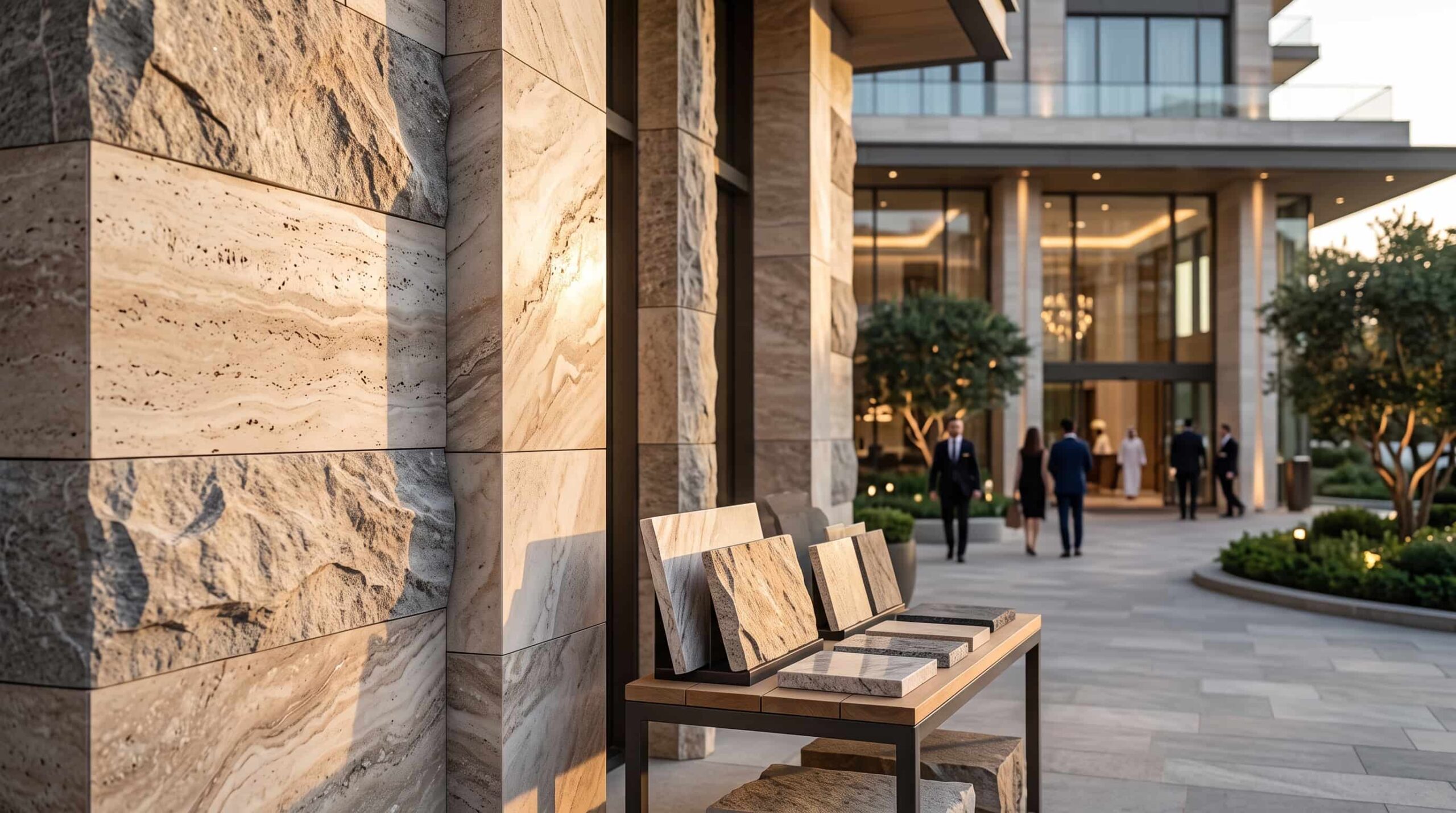
Starting with a stone catalogue is tempting. A more effective approach is to establish the requirements of each application before comparing materials. A lobby floor exposed to luggage wheels throughout the day cannot be evaluated using the same criteria as a reception wall intended primarily for visual impact. Likewise, a restaurant service counter and a decorative wall in a suite have different performance requirements.
Identify foot traffic, water exposure, food and beverage contact, potential impact and cleaning frequency for each area. Include the maintenance team’s working practices in this assessment. A busy city hotel may have a different tolerance for maintenance demands than a boutique property with more limited use.
A practical starting point is to divide the project’s natural stone applications by function. Onyx options can then be assessed for selected decorative surfaces, while marble alternatives with verified suitability can be compared for heavily used areas.
Make the design decision with the operations team
Stone selections are often finalised during the design phase. Yet the staff responsible for daily cleaning play an important role in how those surfaces perform in service. Involving the housekeeping manager, engineering team and procurement staff early can lead to more practical decisions.
For example, a dark polished surface may look striking in a design presentation. However, the visibility of water marks or differences in surface condition should also be assessed under the hotel’s actual lighting. Renderings alone should not determine the final selection.
Testing an approved sample with the proposed cleaning method is useful. Review the cleaning product’s compatibility with the stone, the manufacturer’s instructions and the results on a small test area. This can help reduce disagreements about maintenance expectations after handover.
Onyx or Marble? Let the Application Guide the Choice
Onyx: A visual focal point designed around light
Onyx marble is a name used in the commercial natural stone industry. Architectural stone sold under this name should not automatically be assumed to be the same material as onyx used in jewellery. Request a material description and relevant technical information alongside the commercial name.
One of the most distinctive features of architectural onyx is the opportunity to use translucency for decorative lighting in suitable slabs. However, not every slab produces the same lighting effect. Colour density, veining, thickness and treatments applied to the back of the stone can influence the finished appearance.
When selecting onyx for hotel interiors, an unlit photograph is therefore insufficient. Assess the slab under conditions that reasonably represent the proposed lighting arrangement. A large reception panel may look different from a small illuminated sample.
A considered approach is to use onyx at selected focal points. This allows its visual character to stand out within the overall interior design.
Marble: A material for visual continuity across larger surfaces
Marble offers a versatile selection of colours, distinctive veining patterns, and surface finishes, making it a popular choice for hotel interiors. From elegant lobby floors and decorative wall cladding to vanity surrounds and bespoke furniture details, it can enhance the aesthetic appeal of a wide range of hospitality spaces. When comparing marble with premium natural stones such as Iranian Onyx it is important to evaluate each material’s unique characteristics rather than relying on appearance alone. Differences in composition, translucency, durability, maintenance requirements, and suitability for specific applications should all be considered to ensure the right choice for each hotel project.
Mineral composition, natural discontinuities, filling treatments and surface finish all matter. For a heavily used floor, the decision should consider relevant technical information and installation conditions alongside the desired colour.
The Natural Stone Institute discusses material characteristics and maintenance expectations when evaluating marble and architectural onyx applications. Stone selection should therefore align with the surface changes and maintenance approach that the hotel is prepared to accept.
A quick comparison: Which material should you consider where?
| Selection factor | Approach to onyx | Approach to marble |
|---|---|---|
| Design purpose | Feature surfaces and illuminated visual effects | Visual continuity across larger surfaces |
| Reception backdrop | A strong candidate after lighting trials | A strong candidate with planned vein composition |
| High-traffic flooring | Requires specific technical assessment | Verify the stone and finish for the intended use |
| Bar applications | Consider decorative front panels | Assess staining and acid exposure on working tops |
| Wet areas | Verify material and installation system compatibility | Review water exposure, finish and maintenance |
| Procurement checks | Illuminated samples and actual slab inspection | Batch consistency, finish and relevant technical data |
Lobby and Reception: Create a Strong First Impression with Control

Designing an onyx wall behind reception
Reception is the first service point most guests approach. An onyx wall behind the desk can become a prominent element of the hotel’s identity. For a successful result, however, the stone, signage, reception desk and lighting should be designed together.
A heavily veined slab may reduce the readability of a logo with small lettering. Strong backlighting may also create uncomfortable brightness within the reception staff’s field of view. Assess how the finished installation will function, as well as how the stone looks.
A representative mock-up using the actual materials is the most useful check. Review logo placement, joint positions, desk height and lighting levels within the same composition.
Maintenance access also needs attention. A system that requires stone removal to reach lighting components can make servicing more difficult during hotel operations. Define the access method in the installation design.
Lobby flooring: Traffic matters as much as colour
Guests, staff, luggage trolleys and service equipment may all use the hotel lobby floor. Marble flooring selection should therefore be treated as a performance decision as well as a decorative one.
Sand and dirt carried through entrances can affect surface condition and maintenance. Entrance matting, regular cleaning and appropriate equipment help protect the stone. The Natural Stone Institute recommends suitable entrance mats to reduce the abrasive dirt brought onto stone floors.
Consider furniture, wall finishes and daylight when choosing the colour. Light-coloured stones can influence the perception of the space, while darker options can introduce stronger contrast. The visibility of dirt, scratches and maintenance marks will vary with the selected material and finish.
Before approval, view several alternatives side by side under the proposed lighting. Two marble options that appear similar in photographs may produce different results in the actual interior.
Restaurants and Bars: Balance Statement Surfaces with Everyday Use
Separate the onyx bar front from the working countertop
When considering onyx for a hotel bar, assess the decorative front panel separately from the working countertop. The front panel can create an illuminated design feature. The countertop faces repeated contact with glasses, liquids, service equipment and cleaning products.
This distinction can make maintenance requirements easier to manage. For example, onyx may be used on a protected feature panel while another material is selected for the working surface according to operational requirements. Different parts of the installation do not need to deliver identical performance.
Consider footwear and equipment impacts at the bar front. Discuss protection at the lower edge, panel joints and potential water exposure during cleaning with the installation team.
For illuminated applications, check whether the lighting level supports the bar’s intended atmosphere. A panel that looks appealing in the evening may appear different in daylight. Review both conditions before approval.
Assess acid exposure on restaurant tables and counters
Marble surfaces can be attractive in restaurant interiors. However, acidic substances such as lemon juice, vinegar and some beverages can dull or etch stones containing calcium carbonate. This is different from an ordinary surface stain.
Do not assume that an impregnating sealer prevents every problem. Such products may help reduce liquid absorption under appropriate conditions, but they do not make the stone completely resistant to acid etching. Select products that are compatible with the chosen stone.
Before purchasing, consider the restaurant’s service model. A buffet counter, cocktail bar and decorative host stand do not face the same exposure. Prepare a cleaning and spill-response procedure for each application.
Controlled trials on samples can clarify expectations. Recording the results helps the design and operations teams agree on the surface behaviour they are willing to accept.
Hotel Bathrooms and Spas: Consider the Complete Installation System
Evaluate wet-area stone as part of a system
Natural stone selection for hotel bathrooms should be coordinated with waterproofing, falls to drains, adhesives and jointing materials. An attractive slab cannot compensate for problems caused by an unsuitable substrate or installation system.
Shower walls, shower floors and vanity surrounds are separate applications. They differ in water exposure, cleaning products and intensity of use. For flooring in particular, assess slip behaviour under the intended service conditions.
Ask the supplier for information relevant to using the selected stone in wet areas. The project team and appropriate specialists should determine the necessary testing and verification. The Natural Stone Institute identifies wet-area stone applications as requiring specific consideration of material characteristics and installation details.
Connections and transitions within showers also require attention. Stone cladding does not replace waterproofing. Establish the installation sequence and inspection responsibilities before work begins on site.
Spa design: A calm atmosphere with accessible maintenance
Onyx and marble can contribute to the atmosphere of a spa interior. However, distinguish dry relaxation areas from surfaces that are regularly exposed to water.
A decorative onyx panel may provide a focal point in a suitably designed relaxation area. Where steam, water or cleaning chemicals are present, assess both the stone and the installation system for those conditions.
During sample approval, consider lighting levels and the surface’s appearance after cleaning, as well as its colour. Excessive brightness or uneven illumination can undermine the intended atmosphere of a restful space.
Maintenance access is particularly important. Explain how components behind the panel will be inspected, which areas need protection during cleaning and how servicing will be carried out. The handover file should contain practical maintenance information rather than product names alone.
Hotel Suites: Create a Luxury Impression Through Balance

Does every surface need a statement stone?
In a suite, the impact of stone may depend more on its placement than on the quantity used. A headboard feature panel, entrance console or selected bathroom wall can establish the room’s character.
Using several strongly veined stones in the same room can make the design harder to read. Establish a relationship between the main feature stone and quieter supporting surfaces. Timber, metal, textiles and wall colours should form part of the selection process.
Consider the guest’s different viewpoints. The composition visible from the doorway may differ from the view from the bed. Lighting can also change how the surface is perceived.
If an illuminated onyx panel is proposed, assess its effect on the sleeping area. The ability to switch it off or adjust it to an appropriate level should be considered alongside its decorative appeal.
Plan colour distribution across repeated rooms
A hotel may have many rooms following the same design. Because natural stone slabs vary, expecting identical patterns in every room is unrealistic. An acceptable range of colour and veining can nevertheless be defined.
The procurement team should confirm whether sufficient material is available for the required number of rooms. A later purchase from another batch should not be assumed to match the original delivery.
Plan slab allocation before cutting begins. Grouping similar tones within the same area can support visual consistency. More distinctive patterns may be allocated to selected suites.
Keep slab photographs, identification numbers and cutting plans together. This makes it easier to identify which pieces belong to each room and reduces visual inconsistencies caused by random distribution on site.
Bookmatched Onyx and Marble: Plan Symmetry Before Cutting
A bookmatched composition starts with slab selection
Bookmatching involves arranging suitable slabs so their veining forms a mirrored composition. It can be considered for hotel reception walls, suite interiors and large decorative panels. However, not every group of slabs will produce the same degree of symmetry.
Inspect the available slabs together. Review vein direction, slab sequence and panel dimensions before committing to a bookmatched installation. A general note stating “bookmatch required” is insufficient on its own.
Before cutting natural stone slabs, ensure that all electrical sockets, signage, ventilation openings, and joints are clearly marked on a coordinated cutting plan. This is particularly important when working with Some of the Most Stunning Colored Marbles You Need to Know as distinctive veining and colour variations play a key role in the overall design. A technical opening introduced at a later stage can interrupt a prominent vein or compromise the visual balance of the installation. By integrating architectural details, technical requirements, and slab layouts into a single coordinated drawing, project teams can minimise material waste, maintain pattern continuity, and achieve a precise, visually consistent finish.
Use the approved layout as the installation reference. Reversing a piece or swapping two panels can alter the composition. Clear numbering and installation drawings help prevent these errors.
A small sample cannot show a large composition
A small sample is useful for understanding the stone’s general colour and finish. It cannot fully represent vein movement, colour transitions or the bookmatched effect across a large wall.
For highly visible applications, inspect full slabs. If selection must be carried out remotely, request photographs with scale information and videos showing each complete slab. Images taken under different lighting conditions can also help.
Screen settings affect colour reproduction, so a decision based entirely on digital images introduces uncertainty. Depending on the significance of the application, arrange physical samples or a warehouse inspection.
Keep the scope of approval clear. If a sample represents only the general colour, record that limitation. If specific slabs are selected, include their identification numbers in the procurement documents. This avoids ambiguity about what “approved stone” means.
How Should You Check Slab Quality?
Move beyond the commercial name to relevant technical information
When buying natural stone, do not rely solely on the product name and country of origin. Review information relevant to the intended application, including slab dimensions, thickness, finish and backing treatments.
Not every project requires the same tests. A floor and a decorative wall panel face different service conditions. Select relevant tests according to the application, focusing on information that supports the decision rather than collecting unnecessary documents.
The relationship between a test report and the proposed material also matters. Check the report date, sample description and surface to which the results apply. A report for another stone does not establish the performance of the selected product.
Share the supplier’s information with the installation team. Cutting, handling and fixing methods should be planned with the material’s characteristics in mind.
What should you ask during a visual inspection?
Distinguish natural veining from cracks that require further assessment. Not every line visible in a photograph is a defect, but not every opening should be dismissed as a natural pattern.
Inspect filling and repair treatments, variations in surface gloss, edge damage and backing reinforcements. Ask how these features may affect the intended installation.
For onyx, carry out an illuminated inspection as well. Filled areas and backing treatments may appear different when lit. Establish whether that appearance is acceptable during the sample review.
| Inspection item | Information to request |
|---|---|
| Slab identification | Number, photograph and batch details |
| Dimensions | Actual usable area |
| Thickness | Compliance with the order and agreed tolerances |
| Surface | Finish type and visual consistency |
| Repairs | Details of filling, resin and reinforcement |
| Technical suitability | Information relevant to the application |
| Onyx lighting effect | Appearance under representative illumination |
Backlit Onyx Panels: Details That Shape the Finished Result
Test the stone and lighting together
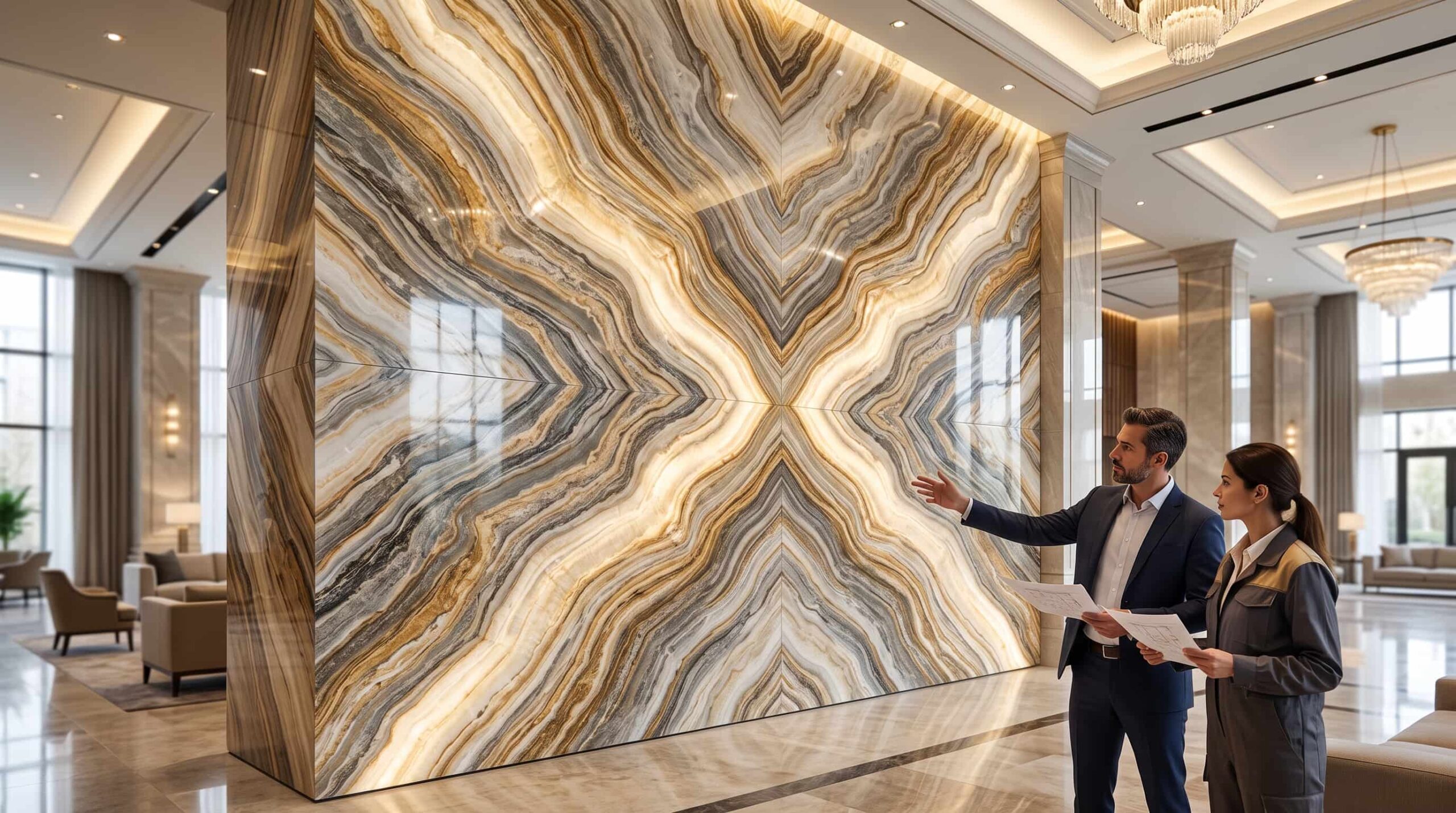
Stone selection and lighting selection should not proceed independently for a backlit onyx panel. The same slab may look different under different light colours and arrangements.
Evaluate the distance between the light source and stone, the distribution of light and the components behind the panel during trials. Do not assume that one selected spacing is appropriate for every installation.
The mock-up should represent the important features of the proposed system. Stone thickness, backing treatments, installation components and lighting equipment should match the planned solution as closely as practical.
During the review, look for visible light points, dark areas and variations around joints. The design team should inspect the panel from different angles rather than approving a photograph alone. Record the approved lighting level and components.
Make servicing access part of the design
Lighting systems may need maintenance during the hotel’s operating life. Plan access to power supplies, connections and control components before installation.
Closing the space behind a panel without an agreed servicing method can make future intervention difficult. The technical team should assess whether access is possible without damaging or removing the stone.
Appropriate specialists should design the electrical and mechanical details. Consider the material, system operating conditions and component manufacturers’ instructions together.
At handover, provide the hotel team with a lighting component list, connection diagram and access procedure. Explain which areas need protection during panel cleaning. A visually successful installation becomes more practical when the operations team can maintain it.
How to Calculate Onyx and Marble Costs for a Hotel Project
The square-metre price is only the starting point
When comparing onyx and marble prices, request quotations with equivalent scopes. The cost of a raw slab cannot be directly compared with the price of cut, processed material ready for installation.
Include slab selection, cutting, edge work, any required reinforcement, packaging, transport and installation in the budget. For illuminated panels, allow separately for the lighting system and servicing access.
The quotation should clearly state what is included. Without agreed taxes, shipping conditions, unloading responsibilities and delivery location, the headline price may not reflect the total cost.
A quotation that initially appears cheaper may become more expensive because of higher cutting waste or omitted services. Base procurement decisions on usable slab area and project requirements as well as unit price.
Calculate waste from the cutting layout
Do not assume that one fixed waste percentage applies to every natural stone installation. Piece dimensions, vein direction, bookmatching and slab characteristics can change the quantity required.
For example, regular floor pieces and a symmetrical feature panel may produce different cutting yields. Unusable edges and the chosen composition can also affect the calculation.
Prepare a cutting layout based on the actual available slabs. Identify spare pieces at this stage too. Material from a matching colour group may not be available later.
| Cost item | Question to clarify |
|---|---|
| Stone | Is pricing based on slabs or net finished area? |
| Cutting | Are vein direction and layout included? |
| Processing | Are edges and special details defined? |
| Logistics | What packaging, transport and unloading are included? |
| Installation | Are substrate preparation and fixings included? |
| Lighting | Are components and service access included? |
| Spare material | Which pieces will be reserved from the same batch? |
A Procurement Plan That Helps Prevent Delays

Collection availability, stock and reservation are different
A stone appearing in a supplier’s collection does not mean the full quantity required for a project is immediately available. Confirm current stock, the number of usable slabs and the quantity that can be allocated.
Agree slab reservations in writing. Understand the reservation period, payment conditions and shipment plan. Otherwise, the slab group approved during design may change before procurement is completed.
Lead time includes more than transport. Consider sample approval, slab selection, cutting drawings, processing, quality control and packaging together.
Working backwards from the hotel’s opening date is useful. Deliveries for critical areas may be separated from other sections where appropriate. However, establish how visual consistency will be managed across different deliveries.
Maintain traceability from warehouse inspection to site delivery
KSM ONYX’s Istanbul warehouse offers the opportunity to inspect onyx and marble slabs, select from available options and assess suitable slabs for bookmatching. Sharing project dimensions and the intended application before a visit can make the inspection more productive.
Record the identification numbers of approved slabs. After cutting, label pieces so they correspond with installation drawings.
Use photographs, packing lists and piece codes during site delivery checks. Define the procedure for reporting missing or damaged pieces in the purchasing agreement.
This system is particularly useful for projects involving many rooms or large decorative panels. Getting the right stone to the right location matters alongside the quality of the material itself.
Stone Selection Is Incomplete Without a Maintenance Plan
Give the cleaning team practical instructions
Do not assume that general-purpose cleaning products are suitable for natural stone. Products should be compatible with the selected material and surface treatment. An unsuitable product can dull an acid-sensitive surface. The Natural Stone Institute recommends planning care according to the stone’s composition and selecting appropriate cleaning products.
A hotel maintenance guide should be concise and usable. Clearly explain daily cleaning, spill response, prohibited products and situations requiring specialist assistance.
Product dilution and rinsing instructions should follow the manufacturer’s guidance. “Clean carefully” is not an adequate procedure. Explain suitable equipment and demonstrate how to test a product on a small, inconspicuous area.
Reserve spare stone and keep maintenance records
Damage or refurbishment needs may arise during hotel operations. Reserving spare pieces from the same batch can help. Determine the quantity according to the size of the installation and the arrangement of replaceable components.
Record where the spare material is stored, its dimensions and the area to which it belongs. Unlabelled pieces make future matching more difficult.
Document maintenance treatments as well. Recording the product used, treatment date and observed results can help when investigating a problem.
If surface restoration becomes necessary, have a specialist determine the appropriate method. Different stains and areas of dulling do not require the same treatment. Intervention without understanding the cause may worsen the appearance.
The Final Procurement Check: Make the Decision with Evidence
Questions to resolve before approval
Before the final decision, the design, procurement, installation and operations teams should review the same information. Document the answers to these questions:
- Where will the selected stone be installed?
- Have the actual slabs and acceptable colour range been approved?
- Has relevant technical information been reviewed?
- Are cutting layouts and vein directions finalised?
- Has a representative illuminated mock-up been assessed?
- Are quotation scope and delivery responsibilities clear?
- Has the operations team accepted the cleaning method?
- Are spare material and maintenance access planned?
The purpose of this review is to reduce uncertainty. Assign unresolved items to the responsible team and complete them before installation. This creates a clearer connection between design expectations and the delivered work.
Conclusion: The Right Hotel Stone Fits the Entire Project
Selecting onyx and marble for hotel projects requires aesthetic goals and everyday use to be considered together. Onyx can create a strong visual focal point in carefully chosen locations with well-planned lighting. Marble can support continuity across different interiors when its suitability for the application has been verified.
A successful selection includes actual slab inspection, technical review, cutting plans and maintenance preparation. Check whether a small sample represents the full installation, compare quotations on equivalent terms and record delivery conditions in writing.
To explore available onyx and marble options with KSM ONYX, share your application areas, approximate quantities, preferred colours and delivery schedule. An Istanbul warehouse visit allows you to inspect slabs and discuss current stock, dimensions and a quotation aligned with your project requirements.
The best starting point is to connect the stone you admire with a clear plan for how it will be used, installed and maintained in your hotel.