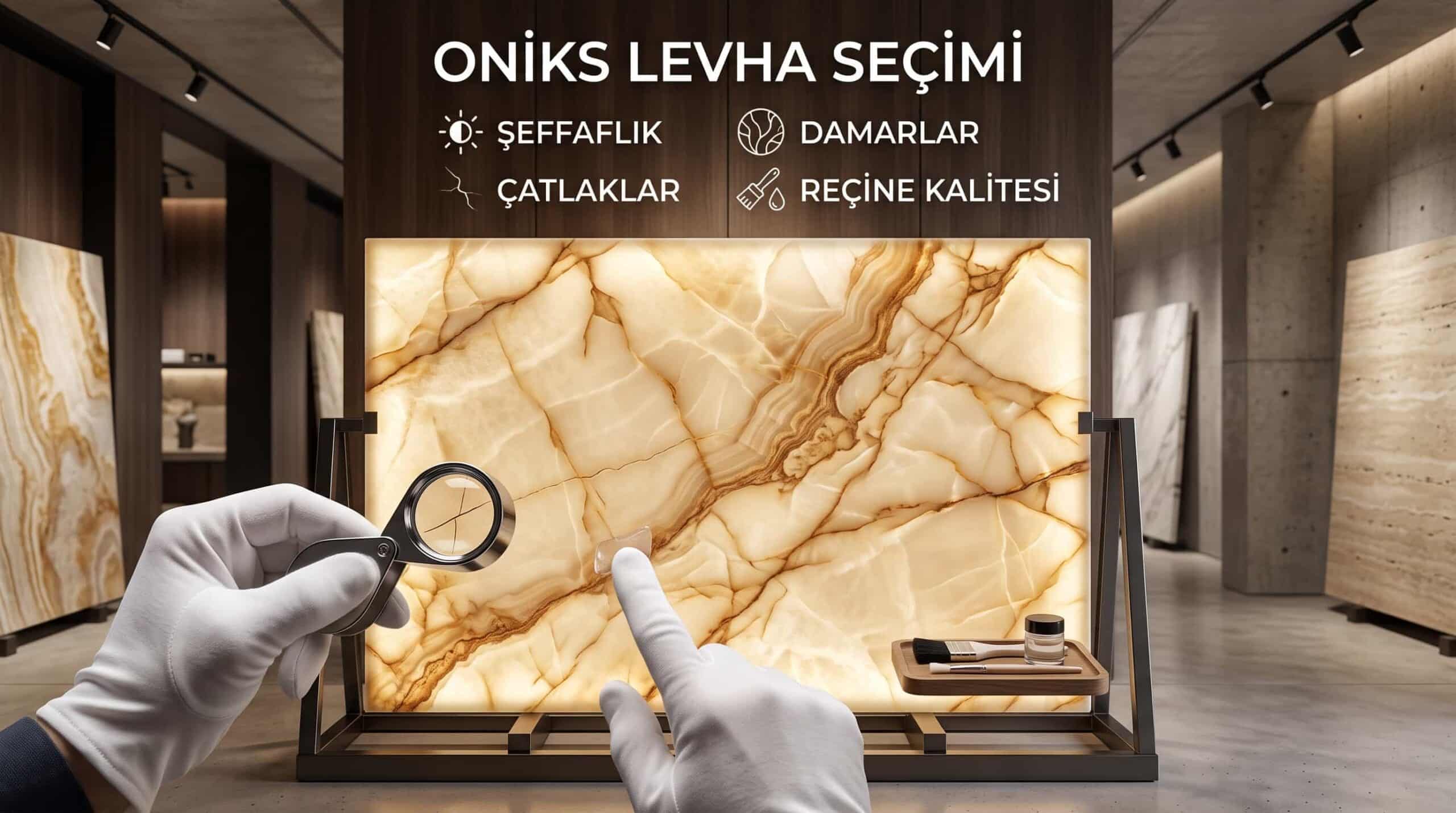
Choosing an onyx slab is not simply a matter of selecting a stone based on its color or how striking it looks from a distance. For natural stone used in luxury residences, hotels, restaurants, retail stores, reception areas, wall cladding and illuminated surfaces, selecting the right slab can directly affect the project’s overall aesthetics, installation results, light performance and long-term user experience.
Onyx stands out from many other natural stones because of its distinctive veining, natural color variations and ability to transmit light. Even two onyx slabs cut from the same block can differ significantly in terms of vein density, color distribution, transparency and overall visual character. For this reason, choosing a slab based solely on a small sample or a few photographs is not always sufficient.
Users searching for terms such as onyx slab, onyx marble slab, transparent onyx, backlit onyx, or illuminated onyx wall are typically looking for more than a basic product description. They need to understand how to determine which slab is the right choice for their specific project, design and lighting requirements.
In this guide, we will explore the key factors to consider when choosing and evaluating an onyx slab, from light transmission, veining, cracks, and resin quality to surface finish, thickness, color consistency, slab integrity, and the intended application. We will also look at how the unique characteristics of Iranian Onyx can influence the appearance and performance of a slab in different architectural and interior design projects. By understanding these factors before making a purchase, you can make a more informed decision and select an onyx slab that combines the right aesthetic appeal, technical suitability, and long-term performance for your project.
içindekiler
- 1 What Criteria Should You Consider When Choosing an Onyx Slab?
- 2 What Is Light Transmission and Why Is It Important for Onyx Slabs?
- 3 How Should the Veining Pattern of an Onyx Slab Be Evaluated?
- 4 How Should Cracks and Fissures Be Evaluated in an Onyx Slab?
- 5 Why Is Resin Quality Important in an Onyx Slab?
- 6 How Should the Thickness of an Onyx Slab Be Selected?
- 7 How Does Surface Finish Affect Onyx Slab Selection?
- 8 How Important Is Color Consistency When Selecting Onyx Slabs?
- 9 How Should an Onyx Slab Be Inspected Before Purchase?
- 10 The Most Common Mistakes When Selecting Onyx Slabs
- 11 How Should You Choose an Onyx Slab for Different Projects?
- 12 What Questions Should You Ask a Professional Onyx Supplier?
- 13 Should You Approve a Sample or the Full Onyx Slab?
- 14 How Should You Select an Onyx Slab for Backlit Applications?
- 15 A Practical Checklist for Evaluating Onyx Slab Quality
- 16 How Can You Identify a High-Quality Onyx Slab?
- 17 Conclusion: How Do You Make the Right Onyx Slab Selection?
- 18 Frequently Asked Questions
- 19 Onyx Slab Selection: How Do You Choose the Right Stone for Your Project?
What Criteria Should You Consider When Choosing an Onyx Slab?
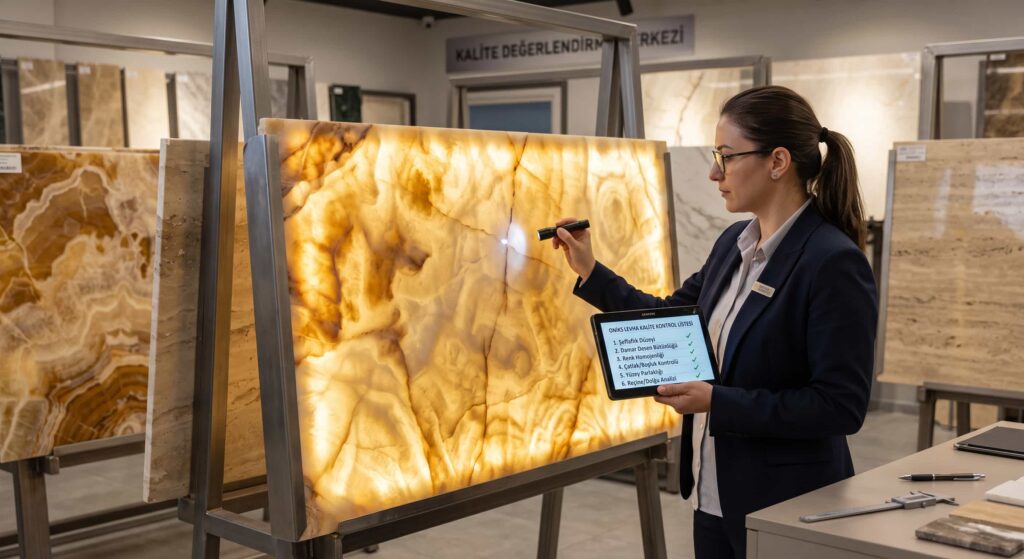
A professional onyx slab selection requires both aesthetic and technical factors to be evaluated together. Choosing a slab based only on its color or the appearance of its veining may not be enough, particularly for large-scale projects where overlooked issues can lead to problems during fabrication, installation, or long-term use.
When evaluating an onyx slab, the following criteria should be considered together:
| Evaluation Criterion | Why It Matters |
|---|---|
| Light Transmission | Determines how light passes through and distributes across the slab, especially in backlit applications. |
| Veining Pattern | Defines the slab’s visual character and affects design continuity and vein-matching possibilities. |
| Cracks and Breaks | Important for fabrication, handling, installation and long-term structural integrity. |
| Resin Quality | Should be assessed in terms of reinforcement, stability and the overall integrity of the slab. |
| Color Distribution | Helps create a consistent and visually balanced appearance throughout the project. |
| Thickness | Can affect installation requirements, support, durability and light transmission. |
| Surface Finish | Influences reflectivity, texture, visual appearance and suitability for the intended application. |
| Slab Dimensions | Affect design planning, layout, material yield and waste calculations, particularly on large surfaces. |
Considering all of these factors together makes it possible to select an onyx slab that is not only visually appealing but also suitable for the project’s specific fabrication, installation, lighting and performance requirements.
What Is Light Transmission and Why Is It Important for Onyx Slabs?
One of the most distinctive characteristics that sets onyx apart from many other decorative natural stones is its light transmission. In particular, white, cream, yellow, honey and light green onyx slabs can allow light to pass through the stone, making their natural veining, color variations and unique patterns more visible. This characteristic transforms onyx from a simple surface material into a powerful visual element in interior design and architectural applications.
However, not every onyx slab has the same level of light transmission. The stone’s color, mineral composition, thickness, vein density and natural formation can all directly affect how light travels through and distributes across the slab. Therefore, when selecting onyx for illuminated applications, it is important to consider not only its color and veining but also how evenly light is transmitted across the entire slab.
Especially in projects where different natural stone options are being considered, the light-transmitting properties of onyx can provide a distinct advantage when compared with more opaque stones with a different visual character, such as Grey Marble Models. For this reason, the intended application, lighting concept, color coordination and desired aesthetic effect should all be evaluated together when selecting the right stone.
How Should Light Transmission Be Evaluated?
When selecting onyx, it is better not to evaluate the stone only under natural daylight or standard showroom lighting. If the slab is intended for a backlit onyx application, conducting a controlled lighting test can provide a much more accurate assessment.
The goal is not simply to answer the question, “Does the stone transmit light?” The more important question is how evenly the light is distributed across the slab and how effectively it reveals the stone’s natural veining and color variations.
A proper evaluation should consider the following:
- How much does light transmission vary across different areas of the slab?
- Do the natural veins become more prominent when the slab is illuminated?
- Do darker areas significantly block or reduce light transmission?
- Does the center of the slab behave similarly to its edges under illumination?
- Are noticeable differences in color or brightness visible behind the slab?
Uniform light distribution becomes particularly important when onyx is used on large feature walls, reception panels, decorative partitions, or other prominent architectural surfaces.
Not Every Transparent Onyx Slab Is Suitable for Backlighting
Transparency alone does not determine whether an onyx slab is suitable for backlighting. A slab may transmit a significant amount of light, but irregular veining or visible effects from resin treatment can produce an unwanted visual result once the stone is illuminated.
For this reason, when selecting onyx for a backlit application, transparency, veining pattern, slab thickness and the backlighting system should be evaluated together. The best result comes from matching the characteristics of the stone with the technical requirements of the lighting system and the visual effect intended for the finished space.
How Should the Veining Pattern of an Onyx Slab Be Evaluated?
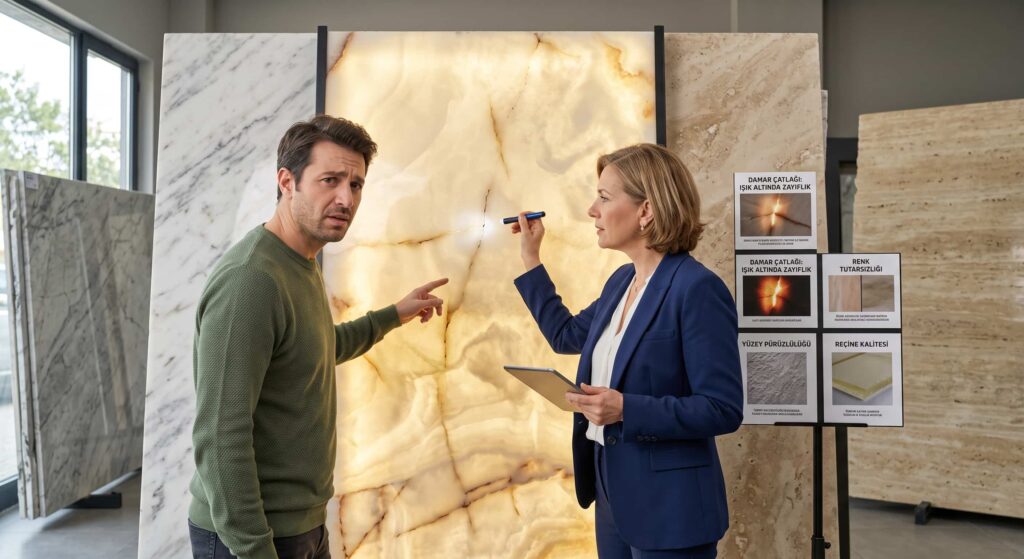
One of the most important factors determining the aesthetic value of onyx is its veining pattern. In natural stone, veins are the result of natural geological formation, which means that two slabs should not be expected to look exactly alike. However, there is an important difference between natural variation and uncontrolled inconsistency.
For a professional project, the veining of the selected slab should complement the overall design concept. Some projects call for calm, balanced veining, while high-end interiors may specifically seek bold and dramatic vein movement to create a strong visual statement.
Vein Density and Direction
When evaluating an onyx slab, it is important to look beyond the color of the veins and consider their density, direction, thickness and distribution across the surface.
For example, on an onyx slab installed behind a long reception desk, horizontally flowing veins can make the surface appear wider and more balanced while adding a strong sense of perspective to the design. In large-scale wall cladding, the continuity and visual flow of the veins across the slabs become even more important. If the veining appears fragmented or poorly aligned across a large surface, it can negatively affect the overall appearance of the installation.
When multiple slabs are required for the same project, their vein direction, color transitions and patterns should be evaluated together to ensure visual compatibility. This approach is not limited to onyx and is equally important when selecting other natural stones. For example, when choosing a High-Quality Black Marble Slab, ensuring consistency in vein direction, color distribution and surface character can help create a more cohesive and refined overall design.
Vein Matching for Bookmatch Applications
Because of its dramatic veining, onyx is frequently selected for bookmatch applications. Bookmatching refers to pairing two slabs so that their patterns create a symmetrical or mirror-like effect. However, simply placing two slabs next to each other does not automatically result in a high-quality bookmatch.
For a successful bookmatch:
- Slabs from the same block or from visually compatible blocks should be selected.
- The continuity and movement of the veining should be carefully checked.
- The color tones should be as closely matched as possible.
- The slab thickness and surface finish should be consistent.
- The orientation of each slab should be determined in advance based on the installation layout.
For this reason, when planning a bookmatched project, it is safer to evaluate the slabs as a complete set rather than selecting a single slab independently. This makes it easier to anticipate the final visual composition and avoid mismatches during installation.
How Should Cracks and Fissures Be Evaluated in an Onyx Slab?
Natural stone can contain mineral veins, natural lines, microcracks and fissures as part of its geological formation. However, not every visible line has the same meaning or level of significance. In onyx slabs, it is particularly important to distinguish between natural veining and actual structural cracks or fissures.
A dark line visible in a photograph may simply be a natural vein, while a similar-looking feature in another area of the slab may be a structural fissure. For this reason, a slab should never be evaluated solely on the visual appearance of a line.
The Difference Between Natural Veining and Cracks
Natural veins are generally part of the stone’s inherent visual character and, when properly incorporated into the design, can add considerable aesthetic value to the slab. Uncontrolled cracks, on the other hand, can create potential risks, particularly during cutting, transportation, fabrication and installation.
When evaluating a crack or fissure, the following factors should be carefully checked:
- Length of the crack or fissure
- Width and extent of the opening
- Location within the slab
- Whether it reaches or breaks through the surface
- Whether it has been stabilized with resin
- Whether it presents any potential structural or handling risk
A professional inspection is particularly important for large-format onyx slabs and pieces intended for demanding applications. A feature that appears minor in a photograph may behave very differently during cutting or installation, so the slab’s physical condition should be assessed before final selection.
Why Is Resin Quality Important in an Onyx Slab?
Resin quality is an important factor when evaluating onyx slabs, particularly slabs containing fissures or those that have undergone a reinforcement process.
In the natural stone industry, resin treatment can serve several purposes. One is to stabilize specific areas of the slab, while another is to improve the workability of natural voids, surface imperfections, or other inherent characteristics of the stone.
However, there is a significant difference between a properly executed resin treatment and a poorly performed filling or reinforcement process.
What Should You Look for in a High-Quality Resin Treatment?

When evaluating resin treatment, looking only at the back of the slab is not enough. The result on the front surface, any visible color changes and the overall visual and structural integrity of the slab should all be assessed together.
Important factors include:
- Uniform and consistent resin application
- No obvious air bubbles or trapped pockets
- No unnecessarily thick areas of resin
- Minimal alteration of the stone’s natural appearance
- No noticeable or unnatural color differences
- Suitability for cutting, fabrication and polishing
Resin should not be used simply to hide a defect. It should be applied using an appropriate technique to stabilize the stone and improve its ability to be safely processed and installed.
Resin Quality Is Not the Same as Visual Quality
An onyx slab may have undergone extensive resin reinforcement, but that alone does not make it the most attractive or highest-quality slab. What matters is whether the resin treatment preserves the stone’s natural appearance, supports its structural integrity and meets the requirements of the intended application.
The real goal is to achieve a balance between the stone’s natural aesthetic character and technical stability.
This is particularly important in premium projects, where the purpose of resin treatment should not be to make the resin itself noticeable, but rather to preserve the natural beauty of the stone as much as possible.
How Should the Thickness of an Onyx Slab Be Selected?
The thickness of an onyx slab is more than a simple physical specification. Slab thickness can affect fabrication, installation, handling, light transmission and, in some applications, the overall visual performance of the stone.
This is particularly relevant in backlit applications, where a thicker slab and a thinner slab may not transmit light in the same way. However, it would be inaccurate to assume that a thinner slab is always better.
When determining the appropriate slab thickness, the following factors should be evaluated together:
| Application | Key Considerations |
|---|---|
| Backlit wall | Light transmission and support system |
| Decorative wall | Flatness, fixing method and surface appearance |
| Table or reception desk | Support, edge detailing and impact risk |
| Bathroom surface | Moisture exposure, installation and surface protection |
| Large-format panel | Handling, cutting, transportation and installation conditions |
For this reason, slab thickness should not be selected solely according to price or availability. It should be determined based on the specific installation requirements and application details.
How Does Surface Finish Affect Onyx Slab Selection?
Onyx slabs can be supplied with different surface finishes and the chosen finish can significantly change the stone’s perceived color, reflectivity and textural character. Common finishes include polished and honed surfaces.
Polished Onyx
A polished surface can enhance the colors and veining of onyx, making the natural patterns appear more vivid and visually pronounced. It is commonly used in luxury interiors, hotel lobbies, wall panels and decorative architectural applications.
However, a high-gloss surface can also make certain surface imperfections more noticeable. For this reason, the quality and consistency of the polishing process are particularly important.
Honed Onyx
A honed finish provides a more matte and understated appearance. It can be a suitable choice for projects that call for a softer, more natural aesthetic.
When selecting a finish, it is important to compare different finish samples of the same stone whenever possible. The same onyx can be perceived very differently under polished and honed finishes, particularly in terms of color depth, reflectivity and the appearance of its veining.
How Important Is Color Consistency When Selecting Onyx Slabs?
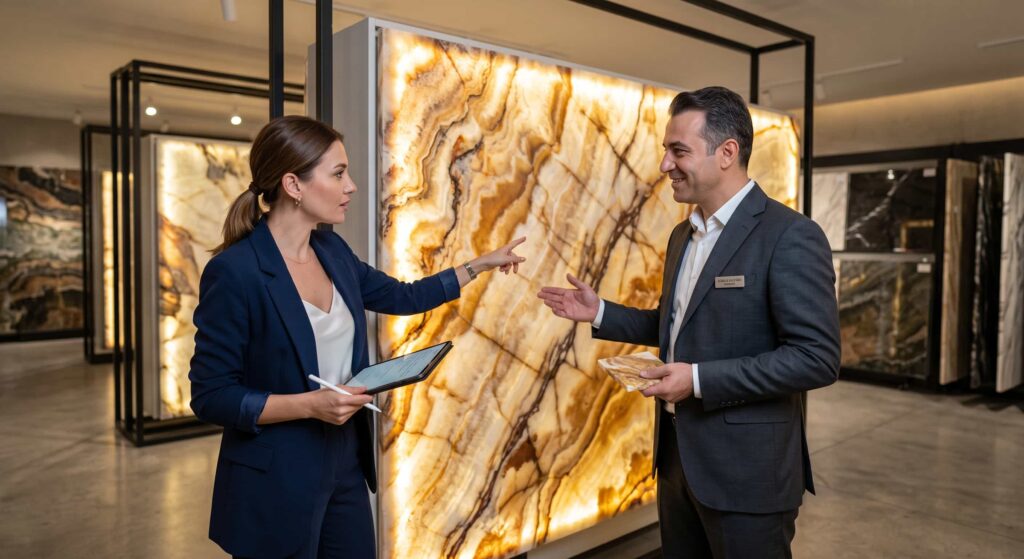
Because onyx is a natural material, some degree of color variation is expected and should not automatically be considered a defect. However, controlled color consistency becomes critical when multiple slabs are used in the same project.
For example, noticeable differences in tone between several consecutive onyx panels in a hotel lobby can disrupt the visual continuity and weaken the overall design.
For this reason, project slabs should ideally be selected from:
- The same block
- The same production or processing batch
- Similar color tones
- Similar vein density and visual character
The Difference Between a Sample and a Full Slab
With naturally veined stones such as onyx, a small sample cannot always fully represent the appearance of an entire slab.
This becomes particularly important with:
- Onyx slabs with strong or dramatic veining
- Bookmatch projects
- Backlit walls
- Large-format wall cladding and other expansive surfaces
For high-value or large-scale projects, relying solely on a small sample is therefore not the ideal purchasing approach. Whenever possible, the full slab should be inspected and approved before final selection.
How Should an Onyx Slab Be Inspected Before Purchase?
During the purchasing process, both the aesthetic appearance and technical suitability of the slab should be evaluated. Ideally, an onyx slab should be inspected from different viewing angles and, whenever possible, under different lighting conditions.
Visual Inspection
The first step is to assess the overall appearance of the slab. Check the color distribution, vein movement, light and dark areas, edge integrity and surface quality.
Structural Inspection
The next step is to evaluate fissures, cracks, breaks, voids, resin-treated areas and reinforcement zones. The objective is not to expect a completely flawless natural stone. Instead, the goal is to determine whether the stone’s existing characteristics are acceptable for the intended application and installation conditions.
Light Testing
If the slab is intended for a backlit application, it should be tested under real or controlled lighting conditions. The assessment should focus not only on whether the stone transmits light, but also on how evenly and effectively it distributes that light across the surface.
Dimensional Inspection
The actual slab dimensions should be checked against the project’s cutting and layout plan. This is particularly important when the design includes columns, door openings, corners, niches, or symmetrical panels. Even a difference of a few centimeters can affect the cutting plan and the final visual composition of the installation.
The Most Common Mistakes When Selecting Onyx Slabs
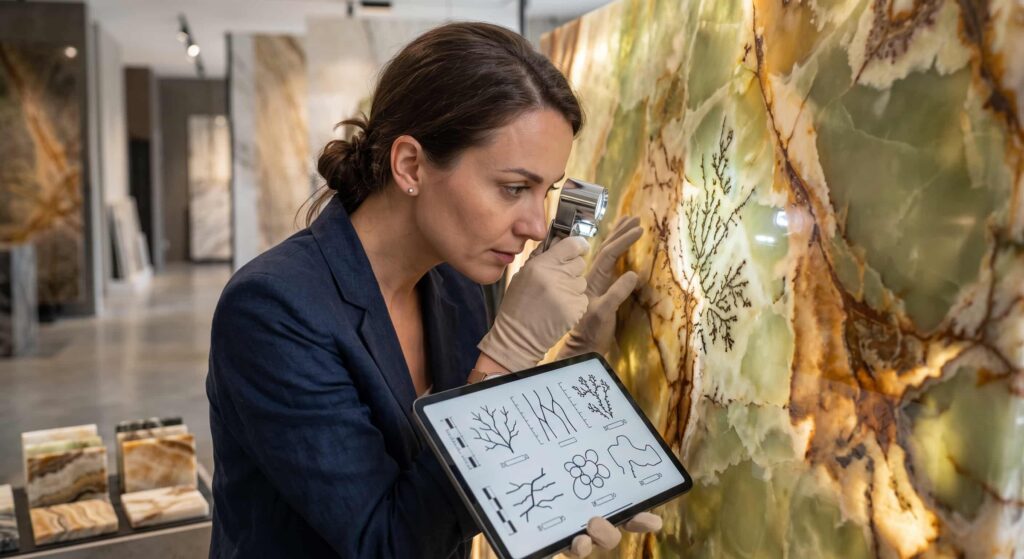
Several mistakes are repeatedly made during the onyx purchasing process. In many cases, the problem is not the stone itself but the purchasing decision being based almost entirely on photographs or price.
Choosing a Slab Based Only on Photos
Professional photography can provide a useful impression of a stone’s character, but it cannot fully represent the actual vein movement, surface texture, thickness, or light transmission of a natural stone.
This is particularly important when purchasing onyx online. Buyers should request recent photographs of the actual slab, along with its dimensions and, whenever possible, a video or lighting test. This provides a much more accurate understanding of what the selected slab will look like in the finished project.
Making a Decision Based Only on Price
Even two onyx slabs sold under the same product name can differ significantly in terms of quality, veining, transparency, processing quality and the presence of cracks or fissures.
For this reason, the price per square meter alone is not a sufficient basis for comparing onyx quality. The stone’s technical and visual characteristics should always be evaluated alongside its price.
Assuming a Small Sample Represents the Entire Slab
A small sample may not accurately represent the rest of an onyx slab, particularly when the stone has strong or dramatic veining.
The full slab can contain significant variations in color, vein density, transparency and pattern. This is why full-slab inspection is especially important for large-scale or high-value projects.
Leaving Backlighting Until the End of the Project
For projects that use illuminated onyx, it is not advisable to select the stone first and consider the lighting system afterward.
The onyx slab, lighting system, support structure and installation method should be planned together. This helps ensure that the selected stone produces the desired lighting effect and performs properly once installed.
How Should You Choose an Onyx Slab for Different Projects?
There is no single type of onyx slab that is ideal for every project. The intended use, lighting conditions, surface area, design language, technical requirements and budget can all influence the selection process.
Onyx for Luxury Hotel Lobbies
In hotel lobbies, bold veining and dramatic color transitions can create a strong visual statement. Bookmatched or backlit onyx can be particularly effective behind large reception desks or on feature walls.
For these projects, it is important to select the slab set together, check the continuity of the veining and minimize noticeable color differences between adjacent slabs. The final layout should ideally be planned before fabrication to ensure that the most visually important areas receive the best-matched sections of stone.
Onyx for Luxury Residential Projects
In residential projects, the appropriate onyx can vary significantly depending on where it will be installed. A living room feature wall, TV unit, fireplace surround, bathroom vanity and kitchen application may each have different technical and aesthetic requirements.
The priority should therefore not simply be to choose the most dramatic or visually impressive stone. Instead, the selected material should be appropriate for the specific use case, installation conditions, maintenance requirements and desired design outcome.
Onyx for Restaurants and Retail Spaces
In restaurants and retail environments, brand identity and visual impact may play an even greater role in material selection. Onyx can be used to create distinctive feature walls, reception areas, counters, display backgrounds and other visually prominent surfaces.
At the same time, factors such as ease of maintenance, exposure to impact, cleaning frequency, surface finish and the lighting system should also be considered. A visually impressive slab is only a successful choice when it can perform appropriately within the conditions of the commercial space.
What Questions Should You Ask a Professional Onyx Supplier?
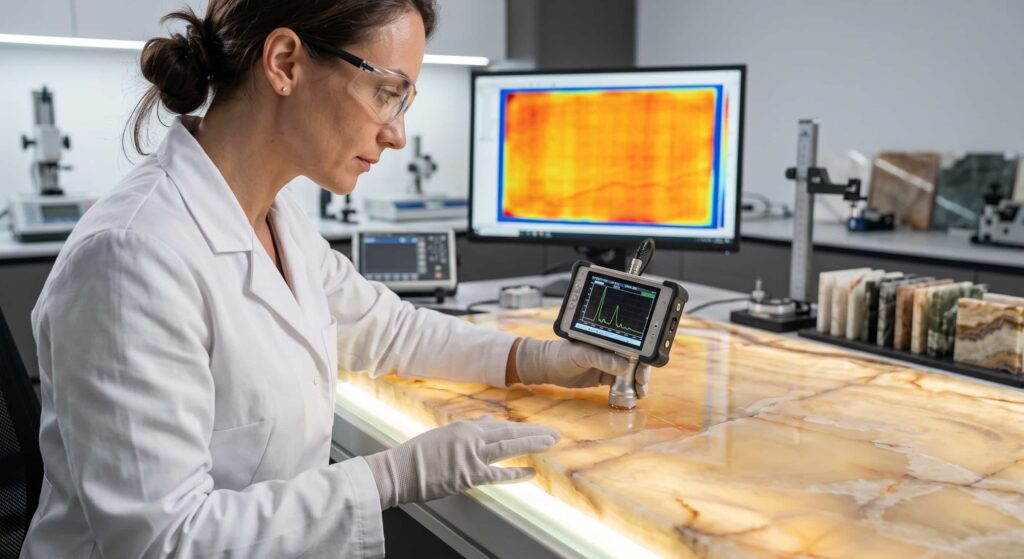
A high-quality purchasing process does not end with selecting a slab. The supplier’s ability to provide clear and accurate technical and visual information about the stone is equally important.
Before purchasing an onyx slab, buyers should obtain clear answers to the following questions:
| Question | Why Ask It? |
|---|---|
| Which block does the slab come from? | Helps identify and match visually compatible slabs. |
| If multiple slabs are available, are they from the same set? | Helps maintain consistency in color and veining. |
| Has the slab undergone resin treatment or reinforcement? | Helps determine its structural condition and processing history. |
| What are the actual slab dimensions? | Important for accurate cutting and layout planning. |
| What is the actual slab thickness? | Helps determine installation and mounting requirements. |
| Is the slab suitable for backlighting? | Helps assess its light transmission and performance. |
| What surface finish does the slab have? | Affects both appearance and suitability for the intended application. |
| Does the slab contain any natural fissures? | Helps evaluate potential cutting, handling and installation risks. |
| Are matching or continuation slabs available? | Important for large-scale projects and multi-slab installations. |
| Is technical support available for cutting and installation? | Can help reduce fabrication and installation risks. |
A professional natural stone supplier should provide transparent information about the stone’s technical and visual characteristics rather than simply quoting a price per square meter. Clear information about the slab’s origin, dimensions, condition, finish and suitability for the intended application can make a significant difference in the success of a project.
Should You Approve a Sample or the Full Onyx Slab?
Small samples are useful for understanding the stone’s general color range, surface character and overall aesthetic. However, with a natural stone such as onyx, which can have significant natural variation, viewing and approving the full slab is a much safer approach for final selection.
A small sample may not reveal a prominent vein, color transition, transparent area, or other visual characteristic that becomes visible in the center or another section of the full slab.
For large-scale projects, the ideal approach is to evaluate the actual slab together with the project design and approve the full slab whenever possible.
This approach is particularly valuable for bookmatch installations, feature walls and backlit onyx applications, where unexpected variations can otherwise lead to design changes or installation challenges later in the project.
How Should You Select an Onyx Slab for Backlit Applications?
In backlit onyx applications, the natural beauty of the stone and the lighting technology work together to create the final visual effect. For this reason, slab selection should consider not only the appearance of the stone under normal lighting but also how light travels through and is distributed across the slab.
An effective selection process for backlit onyx should include the following:
- Test the stone’s light transmission.
- Identify and evaluate darker or more opaque areas.
- Examine how the veining appears under illumination.
- Consider the thickness of the slab.
- Plan how the lighting source will be distributed behind the slab.
- Determine the support and installation system in advance.
The main objective is to achieve a balanced visual effect in which some areas of the stone do not appear excessively bright while others remain noticeably dark. Proper coordination between the onyx slab, light source, thickness, support structure and installation system is essential for achieving a uniform and visually refined backlit result.
A Practical Checklist for Evaluating Onyx Slab Quality
Before purchasing an onyx slab, checking all of the following criteria can make the decision-making process more reliable and professional:
- Appearance: Color, vein movement, light transmission and overall surface integrity
- Structure: Fissures, cracks, breaks and natural voids
- Resin: Application consistency, surface appearance and stabilization quality
- Dimensions: Length, width and thickness
- Surface Finish: Polished, honed, or another specified finish
- Light Performance: Light transmission and uniform light distribution for illuminated applications
- Slab Set: Color and vein compatibility between multiple slabs
- Installation: Suitability for cutting, handling, installation and the support system
- Project Compatibility: Suitability of the selected slab for the intended application and overall design concept
This approach provides a much more professional evaluation standard than simply deciding that a stone “looks beautiful.” Natural stone should be assessed according to how well its visual and technical characteristics match the requirements of the project.
How Can You Identify a High-Quality Onyx Slab?
It is not accurate to define a high-quality onyx slab based on a single characteristic. True quality becomes apparent when the stone’s natural properties are evaluated together with the quality of its processing and preparation.
The key characteristics that can make an onyx slab valuable for a project include appropriate veining, controlled color distribution, high-quality surface finishing, suitable transparency, an acceptable level of fissures, proper resin treatment and physical properties that match the intended application.
This is particularly important in premium projects, where the “most expensive onyx” is not necessarily the “best onyx” for the project.
For example, a highly priced slab with extremely dramatic veining may not be the right choice for a calm, minimalist interior. A more balanced slab could produce a much more successful result in the same space. The purchasing decision should therefore start with the project’s requirements rather than the product price.
Conclusion: How Do You Make the Right Onyx Slab Selection?
Selecting an onyx slab is one of the most visually rewarding yet technically demanding purchasing decisions in the natural stone industry. The stone’s natural veining, color transitions and light-transmitting properties give it a unique character. At the same time, these natural variations mean that not every slab will be suitable for every project.
Instead of focusing only on color or photographs, the selection process should consider light transmission, veining, fissures and cracks, resin quality, thickness, surface finish, color consistency and slab dimensions as a whole.
For visually demanding applications such as backlit onyx and bookmatched onyx, it is particularly important to inspect the actual slab as early as possible and evaluate it together with the project design.
When working with professional natural stone suppliers such as KSM ONYX, buyers should request more than pricing information. The supplier should be able to provide detailed information about the actual slab appearance, dimensions, technical characteristics, recommended applications and availability of matching or continuation slabs.
The right onyx slab is not simply the slab that looks beautiful. It is the slab that properly matches the project’s aesthetic language, technical requirements, lighting plan and installation conditions.
Frequently Asked Questions
What is the most important criterion when selecting an onyx slab?
There is no single criterion that is most important for every project. The selection depends on the intended application, but light transmission, veining, crack and fissure condition, resin quality and overall slab integrity should generally be evaluated together.
How should an onyx slab be selected for a backlit application?
The slab’s light transmission should be tested, with particular attention paid to how evenly light is distributed across the surface. The appearance of the veining under illumination should also be evaluated. Slab thickness and the design of the lighting system should be considered as part of the same selection process.
Are cracks in an onyx slab considered a quality problem?
Not every natural line indicates a quality problem. Natural veining must be distinguished from structural cracks or fissures. The size, location, extent and stabilization of a fissure should be evaluated to determine whether the slab is suitable for the intended application.
Is a resin-treated onyx slab a good choice?
Resin treatment can be used in natural stone to stabilize certain cracks and voids or improve the stone’s workability. What matters is the quality of the resin, the way it has been applied and its effect on the stone’s overall appearance and integrity.
What does bookmatch mean in onyx slabs?
Bookmatching is a decorative installation technique in which two or more slabs are arranged so that their veining creates a symmetrical or mirror-like effect. Because of its dramatic natural veining, onyx is frequently used for bookmatched feature walls and other high-impact architectural applications.
Is a small sample enough when purchasing an onyx slab?
A small sample can provide a general indication of the stone’s color and surface character, but it cannot fully represent the natural veining and variations of an entire slab. For large-scale or high-value projects, it is safer to inspect and approve the full slab whenever possible.
What is the best type of onyx slab?
There is no single “best” onyx slab for every project. The most suitable slab should be selected based on the intended application, design language, lighting conditions, slab dimensions, vein character and technical requirements of the project.
Is onyx the same as “onyx marble”?
The term “onyx marble” is widely used commercially in the natural stone market. However, commercial terminology and geological classification do not always correspond exactly. During the purchasing process, buyers should focus less on the commercial name and more on the stone’s actual technical characteristics, surface finish and suitability for the intended application.
Onyx Slab Selection: How Do You Choose the Right Stone for Your Project?
The foundation of a successful onyx project is not simply choosing a beautiful stone. It is about selecting the right slab for the right application. When light transmission, veining, fissures, resin treatment, color, thickness and surface finish are evaluated together, the result is a more controlled and higher-quality installation.
For architectural and interior design projects, inspecting the actual slab, evaluating multiple slabs as a set and clarifying all technical details before purchase can significantly reduce risks during fabrication and installation.
Ultimately, a successful onyx installation begins long before the stone reaches the job site. Careful slab selection and coordination between the stone, design, lighting, fabrication and installation requirements are what allow the natural beauty of onyx to perform at its best.